Surveillance video evidence for litigation
Surveillance video evidence, preserved and defensible.
Forensic preservation, collection, review and production of CCTV, dashcam and body-worn camera video. Run by eDiscovery specialists and delivered into Everlaw and RelativityOne.
The risk
Footage disappears on a schedule. Courts notice when it does.
7 days
Outback’s cameras overwrote every seven days. The court let the jury presume the lost footage hurt Outback.
30–90 days
CEVA’s security video auto-deleted in 30 to 90 days. The court read its spoliation findings to the jury.
7–30 days
Truck onboard camera systems often overwrite every 7 to 30 days, and sometimes sooner.
Services
From the camera to the production set.
Review platforms transcribe audio, but wiretap laws push camera operators to turn audio off. Surveillance video has to be preserved, collected and reviewed as video. That is all we do.
Preservation
Preservation letters and legal-hold support that name the camera systems, the data and the metadata, sent before the loop overwrites.
Learn more →Forensic collection
Forensic images of DVR and NVR storage, cloud camera exports and documented chain of custody.
Learn more →Dashcam and telematics
Road- and driver-facing video, event data and GPS, preserved and synced to one timeline.
Learn more →Review and production
Multi-camera review on the picture itself, redaction and Bates-numbered productions for your platform.
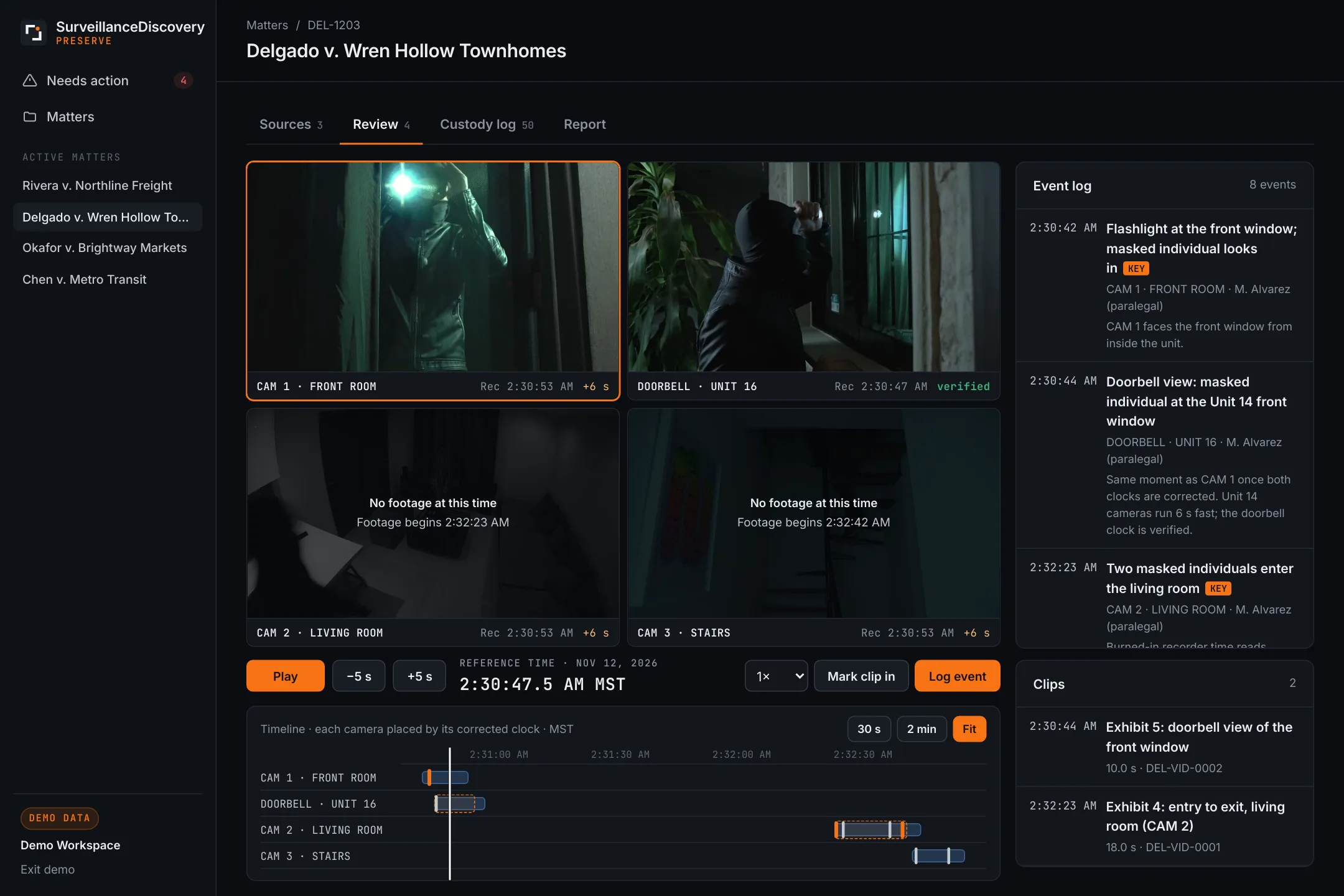
Learn more →SD Review: the review platform built for surveillance video.
Silent, multi-camera footage needs its own tools. SD Review runs on our own matters first, and enterprise programs get early access.
One synced timeline
Every camera aligned to the incident clock using each system’s measured offset.
Event log and key tags
Each relevant moment logged by camera and time, tagged for the case team.
Clips and stills
Cut for depositions, motions and trial, with source and time range recorded.
Redaction
Faces and license plates redacted before production where required.
Platform-native production
Bates-numbered clips with load files for Everlaw and RelativityOne.
Custody on every file
Hash values and chain of custody travel with each clip from collection to production.
Industries
Built for the teams that live with video evidence.
Insurance and claims
Carriers, TPAs and defense panels handling premises, auto and liability claims where video decides liability.
Trucking and fleets
Carriers and their counsel facing claims where dashcam and telematics data are the first thing requested.
Retail, hospitality and property
Operators with many locations and many recorders, each on its own overwrite cycle.
Employers and employment counsel
Workplace footage behind discipline, discrimination, safety and termination claims.
Law firms, plaintiff and defense
Litigation teams that need video handled with the same rigor as the rest of discovery.
Standards
Defensible by design.
Video gets challenged on how it was handled. Every matter runs on one documented method, so the footage authenticates and the process holds up.
- 01
Native preservation
Original recorder formats at original quality, never a screen capture standing in for the source.
- 02
Forensic imaging and hashing
Recorder storage imaged and every file hashed at collection and verified at each hand-off.
- 03
Time you can defend
Each system’s clock offset measured against a reference, so the timeline survives cross-examination.
- 04
Reproducible process
Every step documented so an opposing examiner can repeat it and reach the same result.
Case law tracker
Video spoliation, decided.
Decisions where lost footage changed the case, tracked and summarized.
Nagy v. Outback Steakhouse
The cameras ran on a seven-day loop and only clips were kept. The court found intent to deprive, so the jury may presume the lost footage was unfavorable.
Hollis v. CEVA Logistics
Video auto-deleted after 30 to 90 days. There were no sanctions, but as a curative measure the court read its spoliation findings to the jury.
Questions
What legal and claims teams ask first.
How fast does surveillance footage get overwritten?
It depends on the system and its settings. In Nagy v. Outback Steakhouse the restaurant’s cameras overwrote every seven days. In Hollis v. CEVA Logistics recordings were normally kept 30 to 90 days. Truck onboard cameras often overwrite every 7 to 30 days. Treat every loop as short.
Can footage that has already been overwritten be recovered?
Sometimes. Forensic tools such as Magnet DVR Examiner can recover overwritten or deleted video from some recorders. It is never guaranteed, which is why preservation comes first.
Why not just transcribe the video in our review platform?
Review platforms transcribe speech from the audio track. RelativityOne only analyzes files that have one. Wiretap laws treat audio differently from silent video, and compliance guides tell camera operators to turn audio off. Silent footage has to be reviewed on the picture itself.
Do you work with Everlaw and RelativityOne?
Yes. Productions are built to load into Everlaw or RelativityOne, alongside the rest of your documents.
Do you work for plaintiffs or defendants?
Both. Trucking, premises and employment defense, and plaintiff and personal injury firms.
Are you a law firm?
No. We handle the evidence: preservation, collection, review and production. Legal strategy stays with counsel.
Talk to a specialist
Footage on a loop? Talk to a video evidence specialist today.
Tell us where the cameras are. We will tell you what to preserve, how to collect it and how fast it needs to happen.